Tesla's First True East Coast V4 Supercharger Is Open in Kissimmee. Here's the Catch.
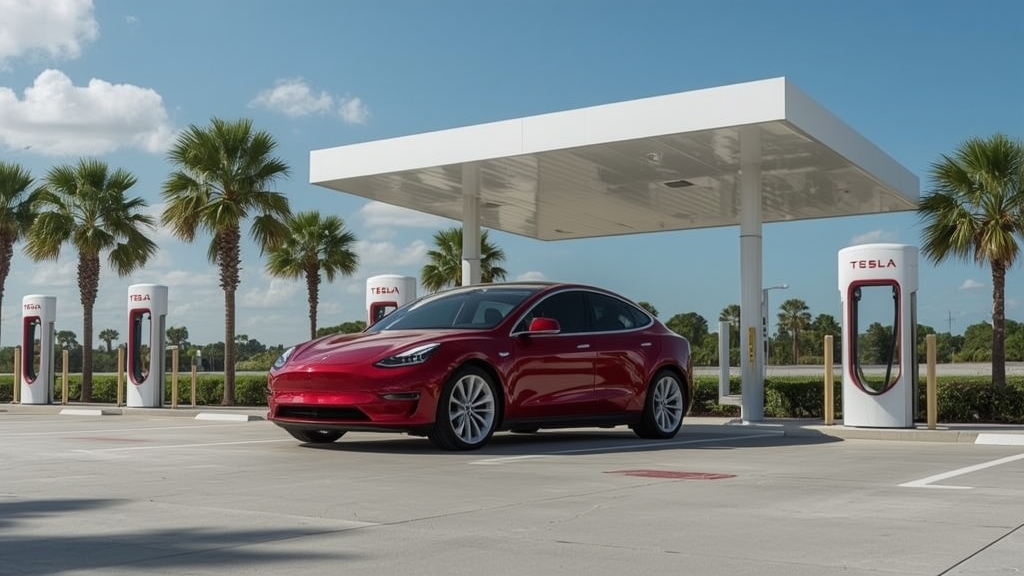
On March 19, 2026, Tesla opened what it's calling the first true V4 Supercharging station on the East Coast, in Kissimmee, Florida near Orlando. Eight stalls. 500 kW per stall capability. A 1.2 MW V4 power cabinet feeding all of them. If you've been watching the V4 rollout since 2023, you already know why the word "true" is doing a lot of heavy lifting in that sentence.
Wait, Hasn't V4 Been Around for Years?
Yes. And that's exactly the point. Tesla has been installing V4 Supercharger dispensers (the physical stalls, the taller ones with the longer cables that reach both sides of the car) since 2023. But most of those installations paired V4 hardware with legacy V3 power cabinets. The result is what some people call "V3.5" stations: they look like V4, they have the NACS ports, but they top out at 250 to 325 kW per stall. Not 500.
Kissimmee is different. The 1.2 MW V4 power cabinet behind it is the real thing, and 500 kW per stall is actually achievable. It's one of only four fully operational 500 kW-capable stations in the country right now. Four. In the entire US.
So when Tesla says "V4," it's worth asking which V4 they mean.
What True V4 Architecture Actually Does
The technical difference matters if you understand what's coming next. V3 systems cap out at 500 volts. V4 supports battery voltages up to 1,000 V. That's the ceiling that makes 500 kW delivery possible, and it's the same architecture that higher-voltage vehicles will need to fully utilize as they come to market.
At under $40,000 per stall (because one 1.2 MW cabinet handles all eight stalls), the economics are reasonable for what you're getting. V3 installations cost more per stall precisely because you need more individual power infrastructure.
Who Actually Benefits Right Now
Here's where I'll be straight with you: if you drive a Model 3 or Model Y, Kissimmee's 500 kW capability doesn't help you much. Your car's onboard charger and battery architecture aren't built for those speeds. You'll still charge at roughly the same rate you always have at a V4 station.
The Cybertruck is the primary beneficiary of true V4 speeds today. It's the vehicle Tesla currently sells that can actually use what 500 kW infrastructure offers. So if you're a Cybertruck owner in Florida, this is genuinely relevant news. For the rest of us, it's groundwork. The stations being built now are the ones that future higher-voltage vehicles will need.
This could mean Tesla is building ahead of its own product roadmap, which is either smart infrastructure planning or a sign that higher-voltage Model variants are closer than we think. One possibility is that the Cybertruck's charging architecture is a preview of where the whole lineup eventually goes.
Non-Tesla Pricing and NACS Access
The Kissimmee pricing breakdown: Tesla owners pay $0.40/kWh during peak hours (8am to midnight) and $0.20/kWh off-peak. Non-Tesla EVs pay $0.56/kWh peak and $0.28/kWh off-peak. And yes, non-Tesla EVs can plug directly into the NACS ports. No adapter required on the station's end, though your car may still need an adapter depending on its port.
The 40% premium for non-Tesla charging is consistent with what Tesla charges at other Supercharger locations. It's not punitive, but it's not the same deal either.
What to Watch For
Four true V4 stations in the US is a small number. If Tesla is serious about deploying this architecture broadly, that number needs to grow significantly before it changes the charging experience for most owners. The Kissimmee station is a proof of concept as much as it's a service announcement.
But the East Coast needed more fast charging infrastructure, and a station capable of 500 kW near one of the country's busiest tourist corridors is a sensible place to start. Road trips through Florida are common for East Coast owners. Having a genuinely fast option near Orlando, where you're likely stopping anyway, is more useful than a faster station in the middle of nowhere.
And if you're a Cybertruck owner heading south this spring, it's worth routing through Kissimmee to see what 500 kW actually feels like in practice.