Tesla's New Basecharger Solves the Overnight Problem for Semi Fleets
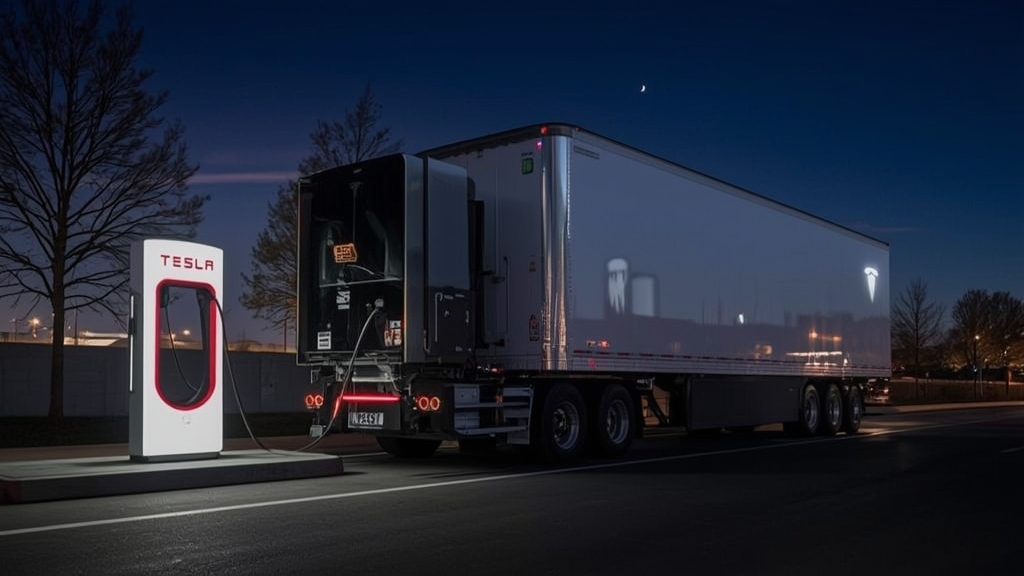
If you're running a fleet of Tesla Semis, you've had one obvious gap in the charging infrastructure: what do you do overnight at the depot? The Megacharger fills range fast (1.2 MW, roughly 30 minutes for a significant boost), but at $188,000 for two posts, it's overkill for trucks that are just sitting idle for eight hours. On May 1, Tesla announced the Basecharger, and it's clearly designed to fill that gap.
What It Is and What It Does
The Basecharger is a 125 kW depot charging solution built specifically for Semi. It delivers up to 60% of the Semi's range in about four hours. For most overnight situations, that's probably enough. If a truck parks at 7 PM and rolls out at 5 AM, four hours of charging in the middle of that window handles it.
The hardware is smarter than it sounds. Tesla used the power module from a V4 Supercharger Cabinet and integrated it directly, which means no separate AC-to-DC cabinet taking up floor space in your depot. The cable runs 6 meters, which matters when you're designing a tight truck yard layout. And here's the feature that actually caught my attention: up to three Basechargers can daisy-chain off a single 125 kVA breaker. That's a real cost savings on electrical infrastructure, which can easily match or exceed the hardware cost itself when you're wiring a depot.
It outputs 150 amps continuous across a 180 to 1,000 VDC range and supports the MCS 3.2 standard.
The Price Math
The Basecharger starts at $40,000 for a minimum order of two units. Compare that to $188,000 for two Megacharger posts. You're looking at roughly one-fifth the hardware cost for a product designed for a completely different use case. Fleet operators building out large depots with both en-route and overnight needs will probably end up with a mix of both, but the Basecharger gives smaller operators (or those just starting with Semi) a way in that doesn't require betting $200k on charging infrastructure before the trucks prove out.
Tesla is also guaranteeing 97% or higher uptime for Basecharger fleet customers, which is the kind of number that matters when you're running logistics operations. A dead charger at 3 AM isn't just an inconvenience.
The Catch
Deliveries don't start until early 2027. If you're deploying Semis this year, you're still figuring out charging without the Basecharger. That's a notable gap. Tesla is targeting 50,000 Semi units annually at its Nevada factory, and the Basecharger won't arrive until those ramp numbers are already well underway. Fleet operators who want Semis in 2026 will need interim solutions.
This could mean the product was announced partly to help close fleet deals now, with the hardware following later. Not unusual for Tesla, but worth knowing if you're in procurement.
Why This Matters Beyond the Hardware
The Semi's biggest practical barrier for fleet adoption isn't the truck itself. It's the charging build-out. Depots that run diesel don't have high-voltage electrical infrastructure. Upgrading is expensive and takes time. Anything that reduces that cost and complexity, like daisy-chaining three units off one breaker, makes the whole Semi proposition easier to say yes to.
Tesla has clearly thought about this from the fleet manager's perspective, not just the engineer's. A 6-meter cable, integrated design, shared breaker capability, and a 97% uptime guarantee are all practical answers to practical objections. That's a different product than "here's a charger, good luck."
Source: Teslarati