Tesla's Texas Plans: $10 Billion Solar Factory, Then Something Called TERAFAB
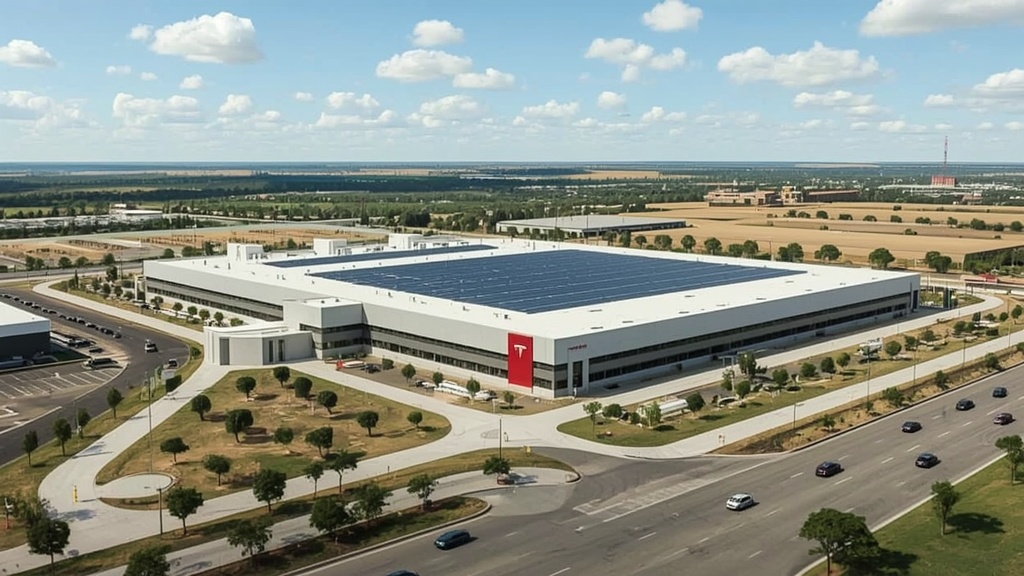
Tesla filed paperwork for a $10.1 billion solar cell factory in Texas, and I've been sitting with the scale of that number for a few days now. For context, that's roughly what some countries spend on their entire energy infrastructure in a year. And this is just one factory. Near Richmond, Texas, about 40 minutes outside Houston, construction is supposed to run from 2026 through 2028, with commercial operations starting Q1 2029.
It's called Project Crystal Sun, which is either a great name or something a marketing team spent three minutes on. I genuinely can't tell.
What's Actually Being Built
The investment breaks down as roughly $1.5 billion in real property (land, buildings) and $8.6 billion in personal property, which in this context means equipment. That ratio tells you something. This isn't a sprawling campus play, it's a manufacturing intensity play. Most of the money is going into machines, not real estate.
The scope includes wafer manufacturing, ingot manufacturing, coating, metallization and printing, cell testing, automation and material handling systems, cleanroom infrastructure, and chemical storage. That's a full vertical stack for solar cell production, not an assembly facility for components made elsewhere.
At full operation, the forecast is 9,712 permanent jobs and 1,147 peak construction jobs. Those are specific enough numbers that someone ran actual modeling, not just rounded to the nearest thousand for a press release.
And Tesla already makes Megapacks in Brookshire, Texas, which is a short drive from the Project Crystal Sun site. So the Texas energy manufacturing cluster is becoming real, not theoretical.
Then There's TERAFAB
Here's where it gets genuinely hard to process.
Tesla and SpaceX are jointly planning something called TERAFAB, also in Texas, with an investment roughly 2 to 2.5 times larger than Project Crystal Sun. That puts it somewhere in the $20-25 billion range. The stated goal is to produce over one terawatt of AI compute annually.
For reference, current global AI compute output is approximately 20 gigawatts per year. TERAFAB's target is 50 times that, from a single facility.
The breakdown of what that compute would do: 80% of the chips are dedicated to orbital AI data centers (that's the SpaceX piece, presumably), and 100-200 gigawatts of terrestrial compute would be dedicated to robotics. Specifically, the plan references supporting production of 1 to 10 billion Optimus units per year and manufacturing 100-200 billion custom AI and memory chips annually.
I want to be honest here: those robotics numbers are so large that I don't know what to do with them analytically. One to ten billion Optimus units per year would mean a robot-to-human ratio that reshapes the concept of manufacturing as it currently exists. This could mean the projections are aspirational to the point of being placeholder math. Or it could mean the planning horizon is genuinely decades out and these are endpoint targets, not five-year forecasts. I don't know which.
What I do know is that Tesla's FSD development has already required significant and growing AI data center investment. The compute demand for autonomous systems is real, it's expensive, and it compounds. TERAFAB reads like an attempt to get ahead of that curve rather than perpetually chase it.
The Texas Pattern
Gigafactory Texas for vehicles. Megapack production in Brookshire. Project Crystal Sun near Richmond. TERAFAB somewhere in the state. At this point Texas isn't just a manufacturing location for Tesla, it's becoming the primary industrial bet.
The solar factory makes straightforward sense given where energy markets are heading and Tesla's existing Powerwall and Megapack business. Vertical integration into solar cell production means Tesla controls more of its own supply chain for stationary storage products, which have been margin-constrained partly by component sourcing.
TERAFAB is harder to evaluate from the outside. The orbital compute angle is clearly SpaceX-driven. The Optimus angle is Tesla. Whether combining them into a single $20-25 billion facility is efficient manufacturing or an extremely ambitious bet on timelines that may not materialize, I genuinely can't say.
But the solar factory? That one I can evaluate, and it looks like a serious, well-scoped industrial investment. Nine thousand permanent jobs, full vertical manufacturing, site already chosen, construction timeline set. That's not a concept, it's a project.
I'll be watching the Q1 2029 commercial operations date closely. That's specific enough to hold someone accountable to.
Source: Cleantechnica