Tesla's Folding Supercharger Is in Europe Now. The Logistics Story Is More Interesting Than the Hardware.
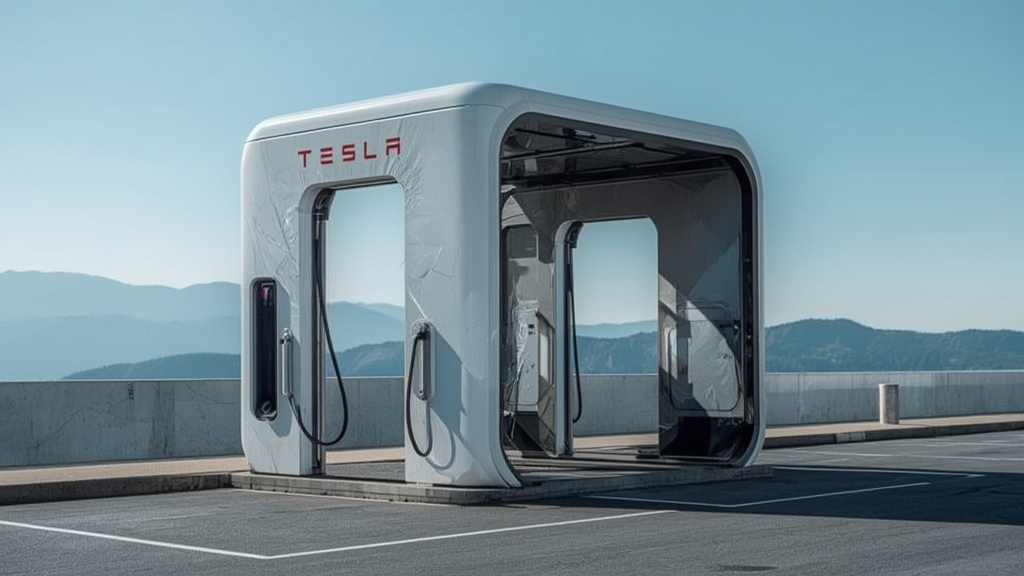
Tesla's Folding Unit Supercharger arrived in Europe this month, with broader rollout targeting major motorway rest stops through the rest of the year. It was introduced in March 2026, so Europe is getting it about three months after the initial launch. The charging specs are V4-class and legitimately fast. But what actually makes this interesting isn't the kilowatts. It's the packaging.
What "Folding" Actually Means
The Folding Unit is a factory pre-assembled V4 charging station built on an industrial hinge system mounted to a heavy-duty concrete base. The telescopic light poles fold down for transport and deploy on-site. The whole thing ships ready to go.
The result: 33% more stalls fit on a single delivery truck compared to traditional installations. Installation time is cut roughly in half. Deployment costs drop by more than 20%.
That's not a small number. If Tesla is building out hundreds of locations a quarter, a 20% cost reduction and 50% faster install time compounds into something significant. This is an infrastructure scaling play more than a hardware play.
The Hardware Is Still V4
Each Folding Unit pairs one V4 power cabinet with eight charging posts. The cabinet delivers up to 500 kW per stall for passenger vehicles and up to 1.2 MW for the Tesla Semi. V4 as a platform puts twice the stalls per cabinet at three times the power density compared to its predecessor.
And the cables are longer than previous Superchargers, which matters because these stations work immediately with non-Tesla vehicles. Ford, GM, Rivian, Hyundai, Stellantis owners can all pull in without an adapter dance. Tesla's charging network has been open to other EVs for a while now, but the hardware is actively designed around that reality at this point.
V3 Is Done
March 2026 was also when Gigafactory New York produced its final V3 Supercharger cabinet. More than seven years of production and 15,000 units total. That's a real number. V3 built out the network in the US and globally. Now that line has stopped.
The switch makes sense. V4 is a better product (more power, more stalls per cabinet) and the Folding Unit format makes V4 cheaper to deploy than V3 was. There's no reason to keep making V3 hardware.
What This Means for Europe Specifically
European Supercharger coverage is patchier than North America, particularly outside of major corridors. Faster, cheaper deployment directly addresses that gap. If Tesla can cut installation time in half and reduce per-location costs by 20%, they can cover more of the map with the same budget.
Whether that actually translates to meaningful coverage improvements depends on how many units they're deploying, which the company hasn't specified publicly. But the tooling is now there to accelerate if they choose to use it.
The Bigger Picture
The Supercharger network has been one of Tesla's real competitive advantages since the beginning. Other automakers are building out charging through third-party networks (which have their own reliability issues). Tesla controls its own hardware, its own software, and now its own deployment economics.
The Folding Unit isn't a flashy announcement. But a 20% cost reduction in charging infrastructure, at scale, is the kind of thing that matters five years from now more than it does today.
Source: Teslarati