Tesla's Supercharger Network Just Crossed 80,000 Stalls. Here's What That Actually Means.
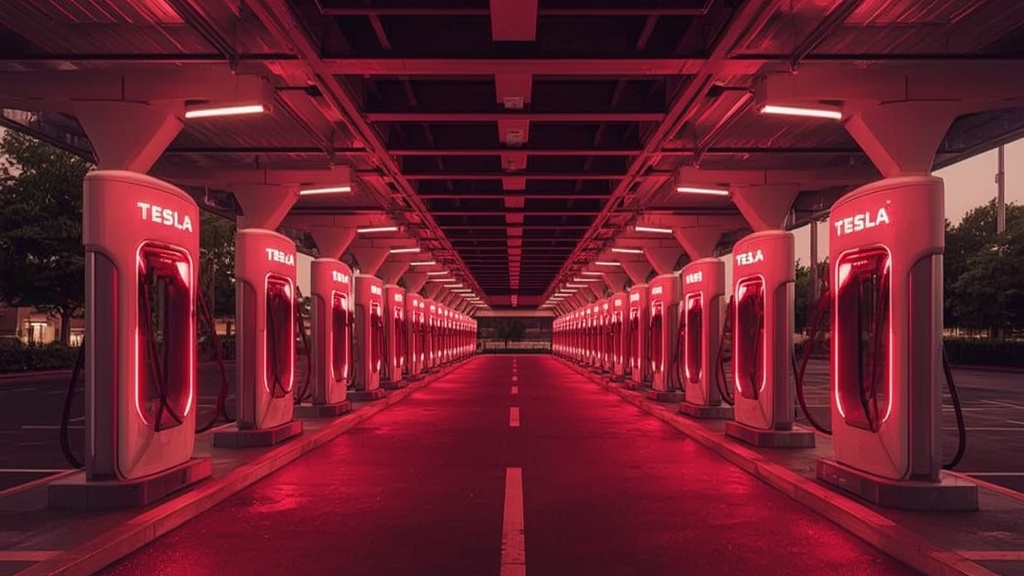
The charging network crossed a quiet milestone recently: Tesla now operates more than 80,000 Supercharger stalls worldwide. That number gets less attention than it deserves, partly because Tesla doesn't make a big deal of it, and partly because the more interesting story isn't the count itself. It's what's happening underneath it.
Three things are shifting at once: the hardware is getting faster and cheaper to deploy, the business model is opening up to outside operators, and the network is becoming genuinely multi-brand infrastructure. Each of those deserves its own look.
The V4 Rollout Is Moving Faster Than People Realize
Gigafactory New York produced its last V3 Supercharger cabinet in March 2026. More than 7 years and 15,000 units, then done. The factory pivoted entirely to V4 production. That's not a soft transition, that's a hard cutover.
The V4 delivers up to 500 kW per stall for passenger vehicles (1.2 MW for the Semi), and supports twice the stalls per cabinet at three times the power density of the V3. But the more interesting engineering story is the new folding V4 design. It ships 33% more units per truck, cuts deployment time in half, and reduces installation cost by roughly 20%. That combination matters a lot when you're trying to scale infrastructure quickly.
The first true 500 kW V4 site on the East Coast opened in Kissimmee, Florida in March 2026. Nashville got a new V4 site the same month. And if you're wondering about the Semi specifically, a public Megacharger launched in Ontario, California in early March 2026, with 37 more Megacharger sites targeted for completion by end of year.
Supercharger for Business: Tesla Is Selling the Network to Other People Now
In September 2025, Tesla launched a program called Supercharger for Business. The concept is straightforward: a business buys and owns Supercharger hardware on their property, Tesla handles everything else (installation, maintenance, software, billing, 24/7 driver support), and the host sets their own retail price per kWh. Tesla takes a flat $0.10/kWh fee to cover the network side. The host keeps the margin.
The hardware isn't cheap. A standard 8-stall V4 site runs approximately $500,000 in hardware and $55,000 per post for installation, coming in just under $1 million all-in. Tesla launched an ROI calculator on April 8, 2026, which suggests they're actively trying to make the business case for potential hosts rather than just selling to obvious partners.
Wawa is the largest host in the program at the moment, with over 2,100 stalls across 223 locations. In early 2026, Wawa opened its first fully owned and branded Supercharger site in Alachua, Florida. That's a convenience store chain treating EV charging as a customer acquisition strategy, which is probably the model that scales.
One thing worth noting: Supercharger for Business stalls are open to all EVs, not just Teslas. So when Wawa installs these, they're essentially building public EV infrastructure with Tesla's backend and their own brand on the front. The incentives align in an interesting way.
The Network Is Now Genuinely Multi-Brand
More than 27,500 Supercharger stalls are now accessible to non-Tesla EVs. Ford, GM, Rivian, Hyundai, and Stellantis brands are all on the network. Stellantis (Dodge, Jeep, Ram, Fiat, Maserati) BEV customers gained access in March 2026, which rounds out most of the major North American brands.
This isn't charity. It's Tesla running a high-margin services business on top of infrastructure they already built for their own customers. The more non-Tesla EVs using the network, the more revenue per stall, the faster they can justify building more stalls, which makes Teslas more attractive to buy. The flywheel is real.
And Then There's Wyoming
Slightly outside the charging conversation but worth mentioning: Tesla is providing batteries for a 200 MW / 1,600 MWh battery energy storage system near Cheyenne, Wyoming, valued at roughly $200 million. It's paired with a 365 MW solar farm. This is Tesla's Megapack business, not Superchargers, but it shows the same pattern. Tesla built hardware expertise for its own products (cars, then the Semi, then stationary storage) and is now selling that capability to utilities and grid operators.
The Wyoming project doesn't affect your daily driving. But it's a reminder that Tesla's energy business is large and growing, even if it gets less attention than the cars.
The Practical Takeaway
If you own a Tesla, 80,000 stalls means fewer waits at popular corridors and more coverage in areas that used to be marginal. The V4 hardware upgrade (500 kW vs. V3's 250 kW peak) means faster top-up stops, especially as battery sizes grow. And the fact that the Kissimmee 500 kW site opened in March 2026 suggests full-speed V4 deployment is no longer just a California thing.
If you're shopping for a non-Tesla EV and charging network coverage matters to you, the math has shifted. Access to 27,500+ stalls across all major brands changes what used to be a meaningful Tesla advantage into a shared asset. That's good for EV adoption broadly, and probably not bad for Tesla either, given the fee structure they're running on non-Tesla sessions.
The network is becoming infrastructure. That's a different thing than a brand perk.
Source: Teslarati