Tesla's LA Supercharger Diner Ranked #1 Globally After One Year
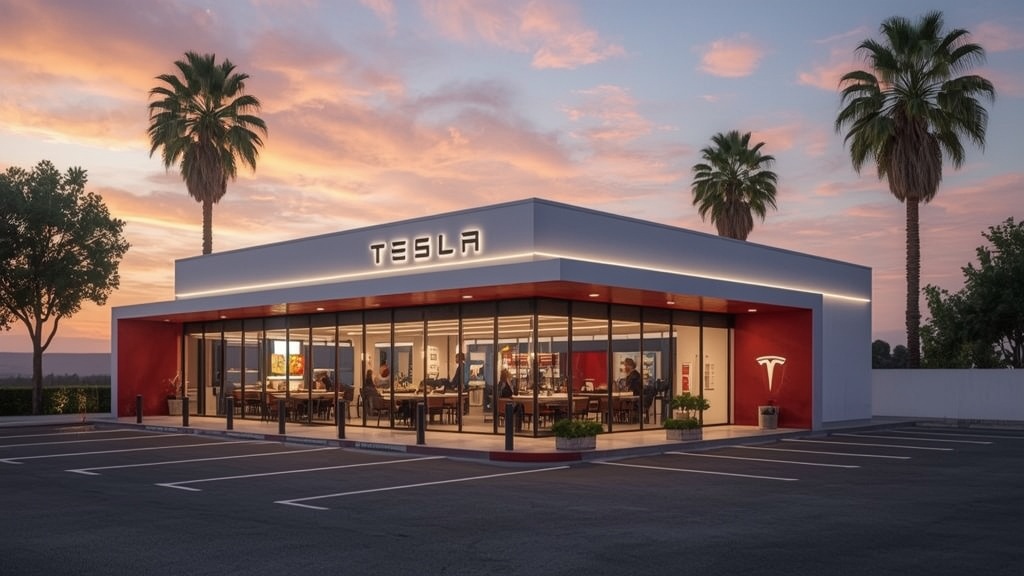
The Tesla Supercharger Diner on Santa Monica Boulevard opened July 21, 2025. One year later, Tesla's head of Charging Max de Zegher shared the numbers on X: 21.2 GWh delivered, 1,600 average daily charging sessions, and the #1 spot in global usage across Tesla's entire Supercharger network.
That last part is worth sitting with. Not #1 in California. Not #1 in North America. #1 globally, out of every Supercharger Tesla operates anywhere on earth.
What Those Numbers Actually Mean
1,600 sessions per day is a lot of cars moving through a single location. And 21.2 GWh over a year means people aren't stopping for a quick 10-minute top-up and leaving. The diner format (something to do while you charge) seems to be pulling in longer sessions, which drives more energy delivered per visit.
LA is a favorable market for this kind of thing. Dense population, high EV adoption rate, and Santa Monica Boulevard is exactly the kind of urban corridor where people are already making stops. But even accounting for location advantages, beating every other Supercharger in the network is a result worth noting.
More Diners? "Mentioned" Is Not "Planned"
Elon Musk has mentioned Palo Alto and Austin as possible future Supercharger Diner locations. But as of July 2026, there are no concrete plans beyond LA. That's a meaningful distinction. "Elon mentioned it" is very different from an actual announcement, and Tesla hasn't committed to building out the format anywhere else.
This could mean the LA site is still in evaluation mode before Tesla decides to replicate it. Or it could mean that building and operating a diner is more operationally complicated than staking out a standard Supercharger, and the economics need more runway. One year of data is good. Scaling a restaurant operation is a different problem than scaling charge points.
Both Palo Alto and Austin make obvious sense given the concentration of Tesla owners in each city (and in Austin's case, proximity to Tesla's headquarters). But right now those are names that came up in conversation, not sites in development.
Meanwhile, NHTSA Is Still Looking at Model 3 Door Releases
Separate from the diner news: NHTSA denied Tesla's petition to dismiss an investigation into approximately 180,000 Model 3 vehicles over emergency door release concerns. The specific issue involves emergency mechanical releases that may be concealed or unlabeled after a vehicle loses power.
NHTSA pointed to a complaint involving a 2022 Model 3 where the emergency release was concealed and unlabeled after the vehicle lost power in a front-end collision. Tesla argued there was no safety-related defect. NHTSA disagreed and is now pursuing rulemaking to require automakers to make emergency egress systems more clearly labeled.
Worth clarifying what this isn't: Tesla vehicles do have mechanical emergency door releases. The handles are electronically operated, with a manual backup for situations where the 12V battery dies. The concern isn't whether the backup exists. It's whether someone under stress in a dark, damaged vehicle can actually find and use it quickly.
That's a fair thing to investigate. And the rulemaking process NHTSA is pursuing would apply broadly to automakers, not just Tesla. If you're driving a Model 3 built in 2022, it wouldn't hurt to find your door release now, before you need it.
The Supercharger Diner numbers are legitimately good. The door release investigation is worth watching. Neither changes the day-to-day ownership experience, but both are part of the picture right now.
Source: Teslarati